





The juiciest fruit: the pomegranate
With a little delay, because in espores we were thinking of talking about the pomegranate in autumn, we bring you a plant with a fascinating fruit. We can find pomegranates everywhere in ethnobotany, such as in mythology, nutrition, art, symbology, utensils… What did this plant do in order to be this famous? Which are its varieties? Which is the most famous pomegranate? Let’s take a look at its colors and flavors to get your appetite with a new edition by Daniel Climent, always willing to go one step further in everything we think we know about a plant.
The pomegranate tree, Punica granatum, is a very interesting plant from an ethnobotanical point of view. Regarding its name, in the southern regions of València, we normally use both mangraner and mangrana, with an epenthetic “n” added to the more etymological version of magraner (pomegranate tree) or magrana (pomegranate). Over the centuries, we have learned how to create bonds with this deciduous bush or tree that go beyond the purely agronomic. Bonds that have crystallized into a very broad cultural polyhedron in which, in addition to the botanical aspects, those of an ethnobotanical character are particularly relevant, such as pharmacology, agronomy, nutrition, biochemistry, cosmetics, basketry, fur fertilization, dyeing, ornamentation, history, mythology, religions, literature, plastic arts, linguistics, paremiology, symbology, heraldry, numismatics, vexillology (flags), children’s games… and we will stop here because we don’t want to tire the reader.
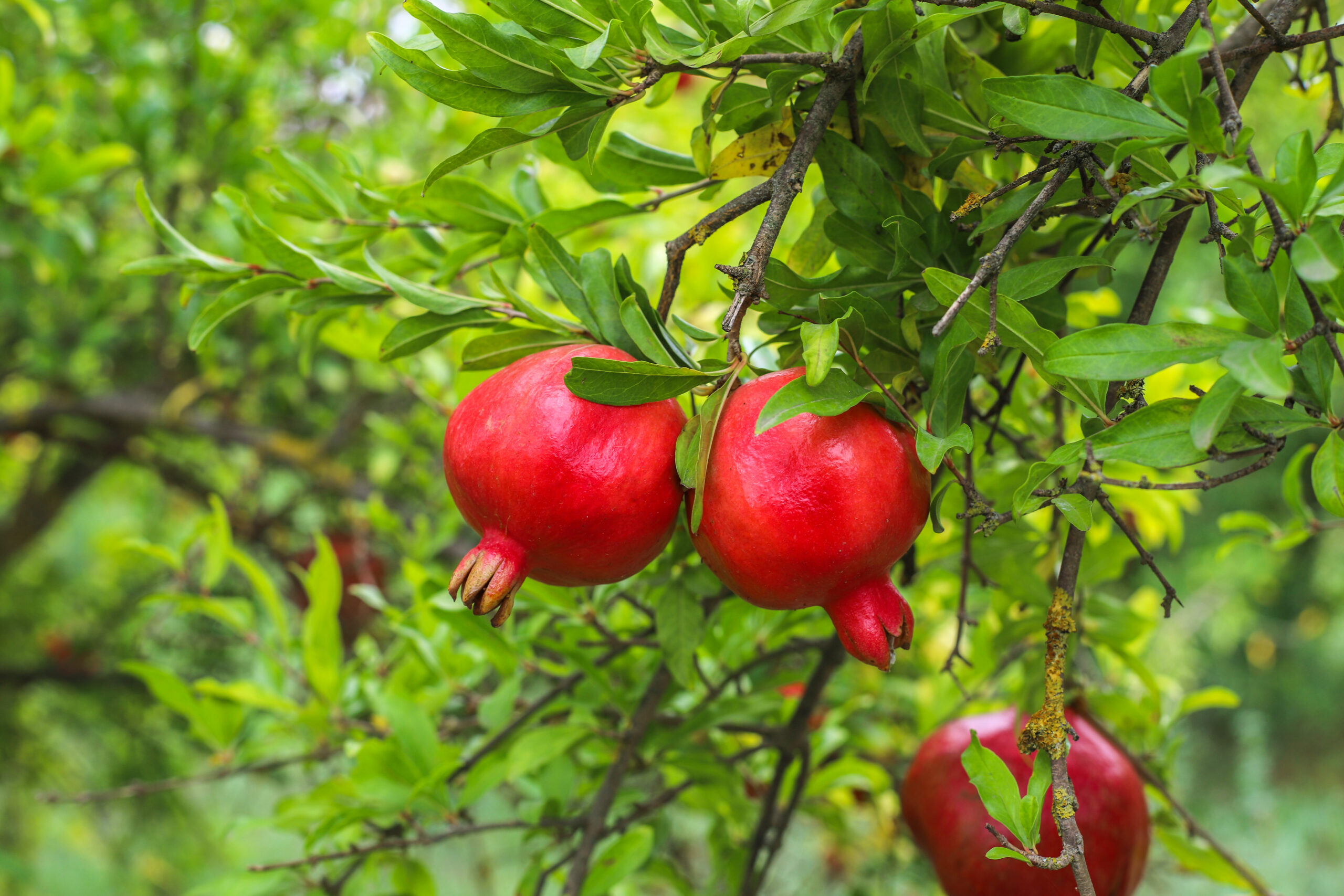
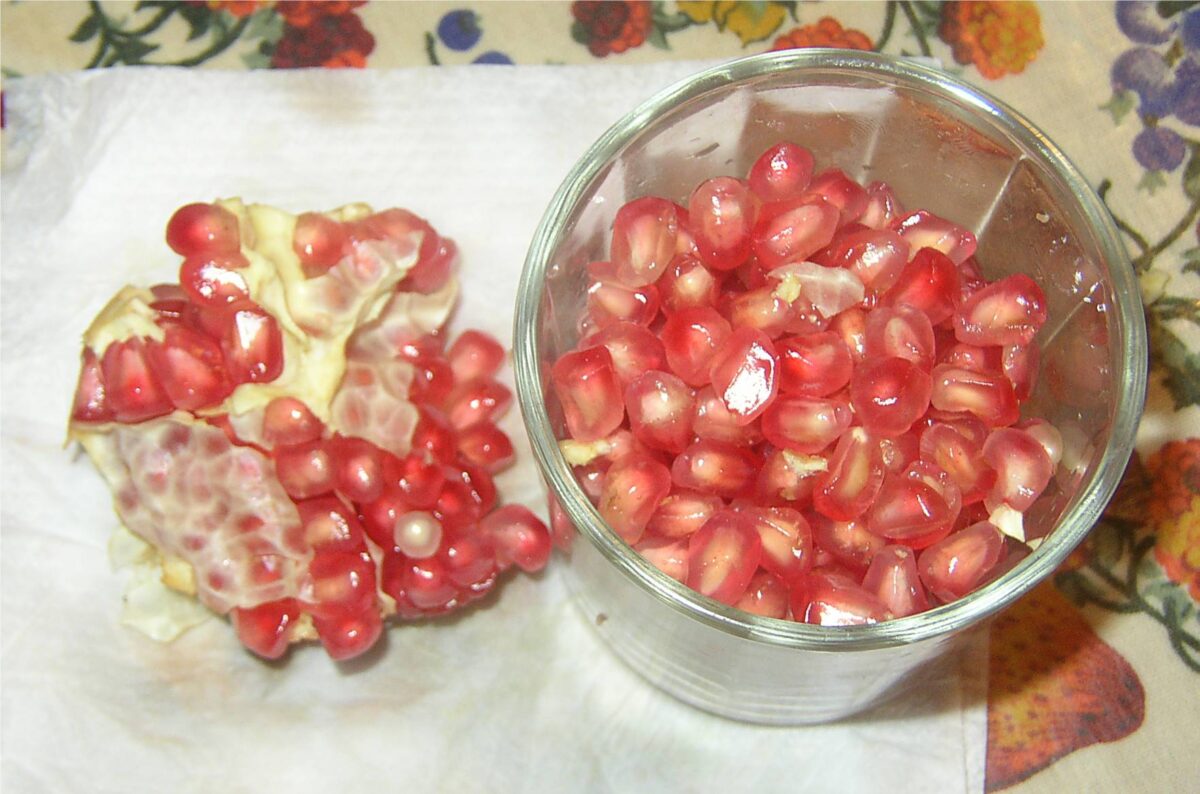
In origin, the pomegranate tree was a deciduous and spiny bush naturally distributed from the Caucasus to the Himalayas, and that produced an edible fruit, the pomegranate. Later, after perfectioning the agronomic techniques, cultivars of saplings with few spines and more accessible fruits were obtained. It must be said that these fruits are very rare within the plant world: a fruit with a leathery skin and a peculiar shape, a type of pouch that contains multiple seeds inside surrounded by a translucent and juicy pulp; arils with different gradations between sweet and sour, and colors that go from pale pink to bright red. They are grouped and compartmentalized by semi-transparent membranes.
It took centuries of improvement by selection of larger and sweeter mutants, advances for which we have to thank the skilled Sumerian, Akkadian, Chaldean (Babylonian), Hindu and Egyptian farmers. And even the Assyrians (upper Mesopotamia), who associated the abundance of large pomegranate contents with their god of fertility, Rimon. A divinity that was later adopted as their own by the Syrians (between Anatolia and Arabia), Phoenicians and Canaanites, and that had its main sanctuary in Damascus, the capital of Syria.
Phoenicians’ love of pomegranates led them to spread their cultivation to the shores of the Mediterranean and, in particular, to one of their foundations, Carthage. And it was the Punics or Carthaginians, heirs of the Phoenicians of Tyre, who promoted and extraordinarily improved the cultivation of pomegranate trees under the leadership of one of the greatest agronomists of antiquity, Magó (3rd century BC). The exportation of pomegranates was one of the most lucrative activities of the Carthaginians to the extent that pomegranates were known everywhere as malum punicum, “Punic apples”.
The pomegranate tree became so representative of Carthage that Scipio Africanus, after defeating Hannibal at Zama, planted a pomegranate tree in the Roman Quirinal to commemorate the battle. He did so in the temple dedicated to the god of war, Chiri (the equivalent of Mars), in the direction of which an avenue called Via ad malum punicum (currently Vía delle Quattro Fontane) was opened.
As for our our home, we know that it is a very old cultivation in the Valencian midlands, in the region of the Baix Vinalopó. In fact, at the archaeological site of l’Alcúdia (the same one where the Dama d’Elx was found), charred pomegranates from the 1st century BC have been discovered, as well as pottery from the late Iberian period (2nd – 4th century BC) with pomegranate engravings, which are easy to identify due to the peculiar morphology of the fruit.
Centuries later, Muslims also developed a special love for pomegranates and pomegranate trees, prefigurations of paradise or Jannah, in which “there will be fruit, palm trees and pomegranate trees” (Sura 55,68, Quran:). Accordingly, Andalusian agronomists strove to obtain pomegranates of the best quality, as is evident in the “Treatise on Agriculture” by the Sevillian al-Awam (12th – 13th century), or by studying ancient Andalusian gardens, or by visiting the current Moroccan ones.
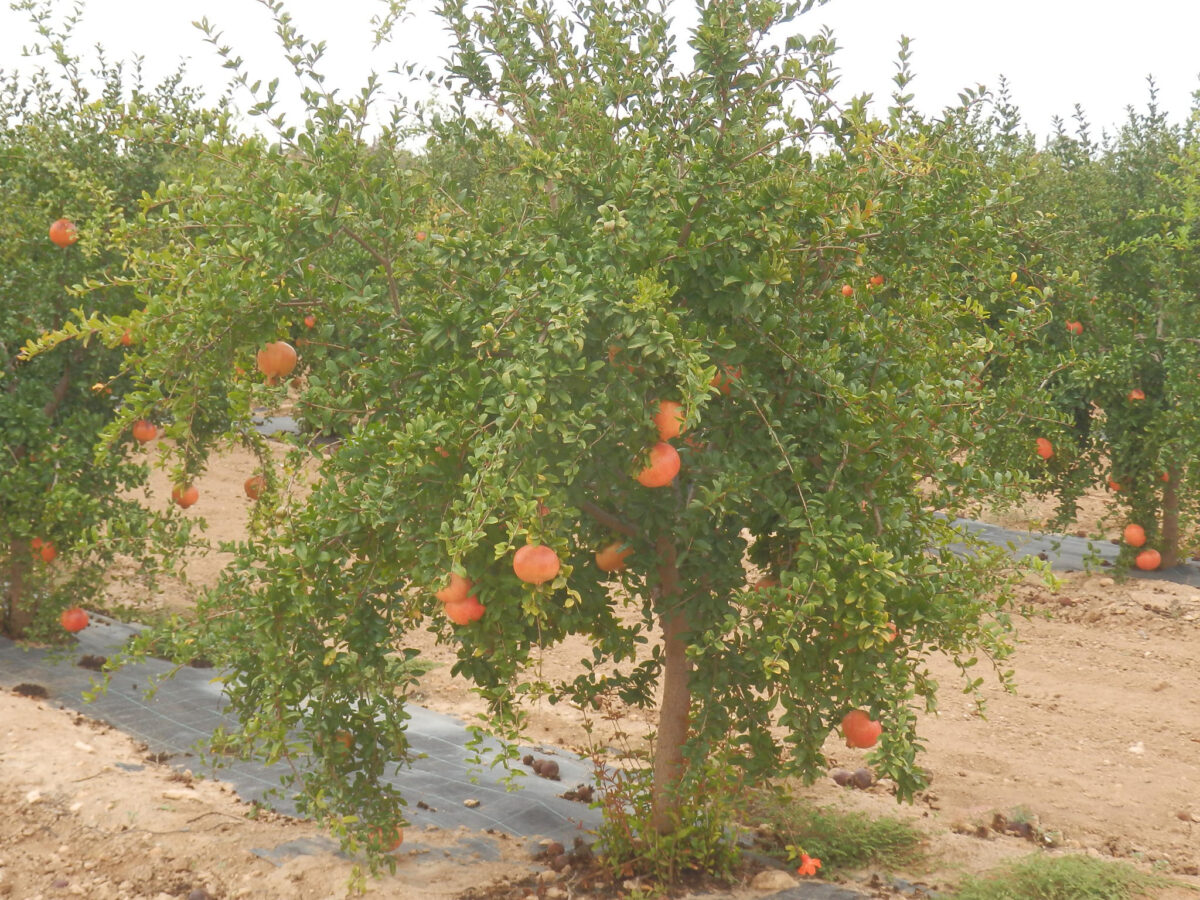
Some gardens and orchards that encouraged all types of agronomic experiments, some of which we inherited in our more southern lands with varieties. For example the albar, edible although it is slightly more sour than sweet; the sweet albar, with big and very sweet grains; the agria, small, with a reddish skin and a sour taste; the precious, large, red, sour and with seeds, which ripens late; the tendral, the best quality, with big grains, small seeds and a lot of juice, even though its rind is so thin that it is marked at the slightest blow; the pinyolenca, with more stone than aril; and the Sacaries, small and very sweet.
The varieties that escape from cultivation, those naturalized by the margins of irrigation ditches and canals, deserve a separate chapter. In this cases they tend to recover their original aspect, bushy and spiny, with smaller pomegranates, with grains that are not too red, less juicy and with an acidic taste. In our case, in Elx (Baix Vinalopó, País Valencià), these wild specimens are called “salleiers” or “de sallei”, referring to the expression “de sa llei”, in the sense that “they go their own way”, without anyone cultivating them. And, above all, the icon of the Elx countryside, also widely cultivated in the neighboring regions of l’Alacantí and Baix Segura, being the most produced variety in the whole country and the most exported one.
And all these varieties go together with another “pomegranate”, now symbolic, the one of the Misteri d’Elx: an articulated “cloud” that opens in gallons and descends in order to gather and ascend to heaven in body and soul (Assumption) to crown the recently dead Virgin Mary. The sacred drama, the Misteri d’Elx, is performed on 14th and 15th August; it is the only one medieval technique performed for more than five hundred years, and has been declared Intangible Cultural Heritage of Humanity by UNESCO.
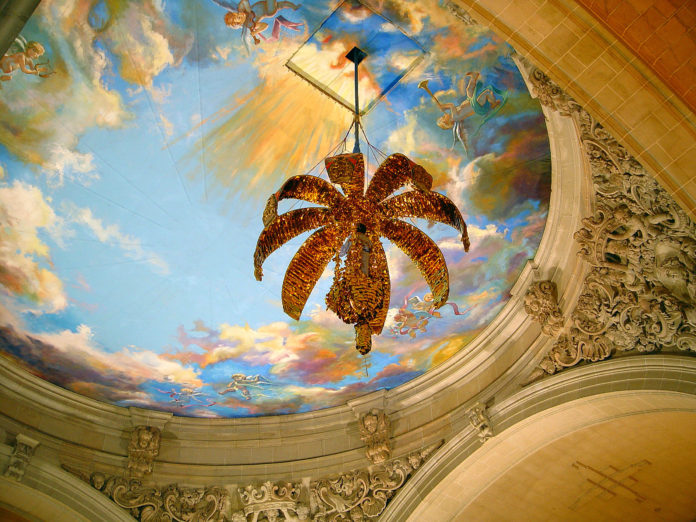
The “pomegranate” of the Misteri d’Elx, opening with the angel descending from heaven. / spania.no
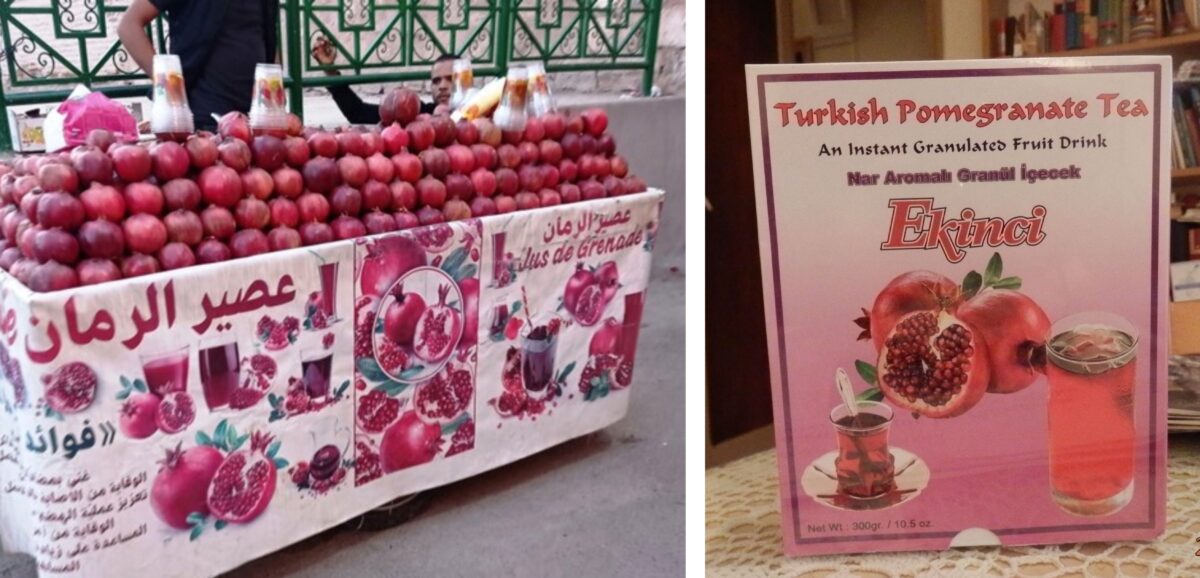
Of the organoleptic characteristics of the “mollar” it is worth highlighting the well-balanced sweetness, a stone so soft that you can barely notice it, and its external color, which varies from cream to bright red (depending on the exposure to sunlight that the fruit had on the tree). However, it is not the most cultivated internationally, since the tastes for other types of pomegranates differ considerably from one country to another: in Mediterranean countries and part of Europe, the “sweet” varieties are preferred as dessert fruits. But in English-speaking, Central European and Scandinavian countries, they prefer the more sour or bittersweet ones for salads, juices and refreshing drinks. For example, grenadine, a very nice and refreshing syrup, which is also useful to treat sore throats. As a result, of the more than five hundred varieties that exist, the most cultivated in the world is the wonderful, acid, with a more marked stone and a bright red color, both the inner arils and the outer cover.
So, let’s enjoy the pomegranates, of course. But also everything that humans have been able to create inspired by them. From the cultivations of pomegranates, to sublime poetry and, obviously, pictorial works like these two with which we close this article.
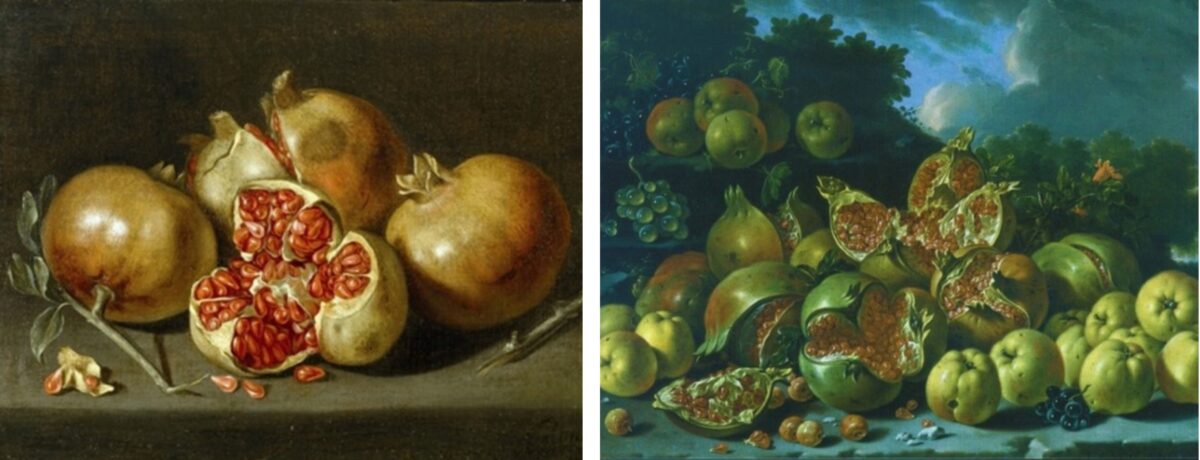
The palatal enjoyment of fruits, as well as the poetic and pictorial ones, consciously understood, are also part of ethnobotany. Of an affective ethnobotany that we also need to revindicate.
This article was written with Vicent Oncina Climent, an agricultural engineer from the Miguel Hernández University of Elx, who dedicated his final year project to the cultivation of pomegranate trees.
Resources and additional information
References
Painting “Bodegón con granadas”
Painting “Bodegón con granadas, Manzanas, acerolas y uvas en un paisaje”
Vídeos
UPUA mangraner, Hades, Persèfone 131018
La Vila, passeig Amadòrio, mangrana, Hades, Persèfone
Daniel, mangrana, Proserpina o Persèfone.
Etnobotànica infantil. Simular fumar amb pipes fetes de mangrana. Jocs infantils. Daniel Climent
Recommended bibliography (in chronological order)
Font Quer, P. 1978. Plantas medicinales. El Dioscórides renovado. Labor. Barcelona.
Climent, D. 1985. Les nostres plantes [comarques meridionals valencianes]. Institut d’Estudis Juan Gil Albert. Diputació d’Alacant.
Climent, D. 1992. Les nostres plantes. Una aproximació multidisciplinar al món vegetal de les nostres terres [Països Catalans]. Editorial Aguaclara. Alacant.
Melgarejo, P. & Martínez, R. El granado. 1992. Ediciones Mundi-prensa.
Zurriaga, F. & Climent, D. 2012. Herbari. Viure amb les plantes. Universitat de València.