






EduCITY Application: uniting nature and technology for a sustainable future

This week at Espores we present an innovative environmental education project developed by the University of Aveiro. EduCITY uses mobile technology to involve and empower citizens in environmental preservation and has had the support of a broad multidisciplinary team. Three of the promoters of this mobile application tell us all the details of this magnificent educational tool that not only promotes sustainability, but also aims to raise awareness among the population about environmental challenges, thus driving a more aware and active citizenship in protecting the environment.
The growing prevalence of mobile devices presents a promising opportunity to explore the potential of digital educational games in outdoor environments. When augmented reality (AR) content is incorporated, these games have the possibility to significantly improve educational outcomes and change citizens’ attitudes towards sustainability. The EduCITY project, developed at the University of Aveiro (Portugal), exemplifies this potential through the perfect integration of park spaces with the broader urban landscape and with other cities. By fostering a strong network between universities, schools, municipalities and businesses, EduCITY promotes knowledge exchange and empowers individuals to actively contribute to urban sustainability. This innovative approach not only enriches local communities, but also serves as an inspiring model for cities around the world, beginning to adopt and adapt these transformative solutions.
The use of territory as a living experimental laboratory, bringing education to a real-life context
EduCITY, “Smart and sustainable cities with augmented reality mobile educational games made by and for citizens” is a research and training project, funded by the Portuguese Foundation for Science and Technology (FCT), whose viability is supported by a multidisciplinary team from four research units with expertise in Education, Botany, Sustainability and AR mobile games, from the University of Aveiro in Portugal.
EduCITY aims to promote sustainable urban development through the creation of an intelligent and innovative learning environment. This is supported by a mobile application that features location-based games with AR educational content, such as environmental sensor data simulations, 3D animations and points of interest. These games can be created in collaboration with teachers, students of all educational levels and the general community through training courses and workshops. Designed to be engaging and interdisciplinary, these challenges can be explored by anyone while walking through the city. This innovative educational approach uses everyday technology (mobile devices) for hands-on learning. AR games promote environmental awareness, transforming the city into a living laboratory where citizens become “active science” and drivers of sustainable change.
An example of a question asked in a game integrated into the EduCITY application
As illustrated in Figure 1A, on the application’s home screen, players have the option to start a new game (novo jogo), access free mode (modo livre), view their scores (pontuações), learn how to play (como jogar), view the project credits (créditos) or exit the application (sair). When players access the ‘new game’ option, they can analyse a list of games available in the application and select what they would like to play. There are two language options: Portuguese and English. During the game, the player is accompanied by the project mascot, the Flamingo, an emblematic species of Aveiro, which provides explanations about the game in the questions section, instructions on how to reach each of the points of interest (Figure 1B), an introduction to the question with the selected resources (Figure 1C) and comments on the answers selected by the player.
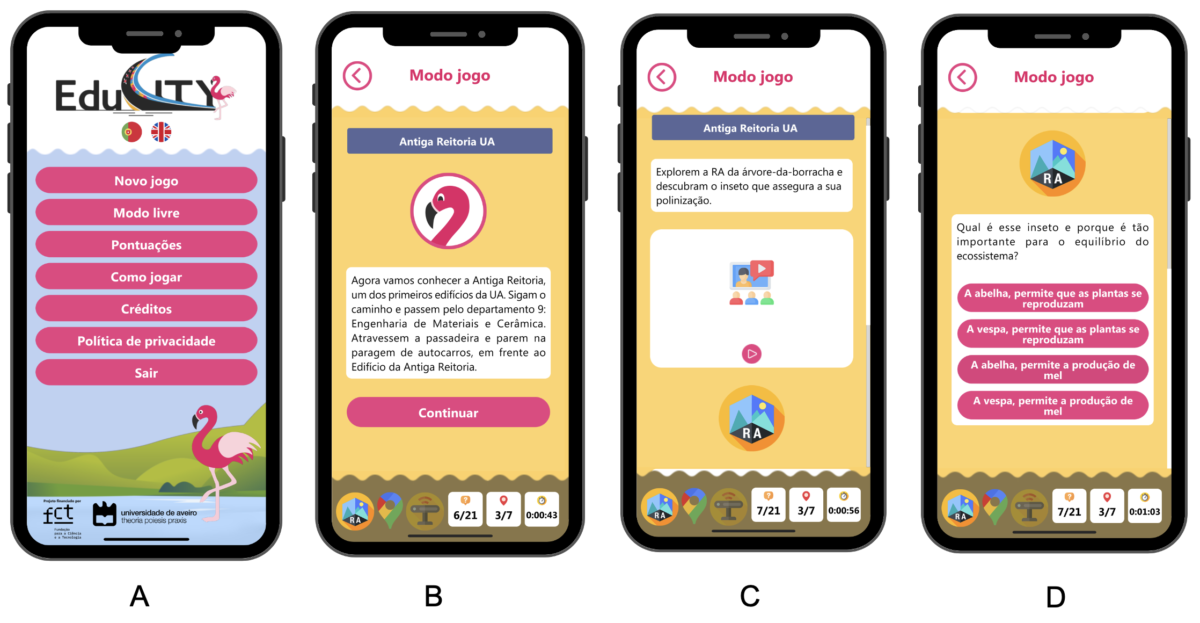
In this question, players visit the Old Rectory Point of Interest at the University of Aveiro and explore with AR the Indian rubber fig tree (Ficus elastica Roxb. ex Hornem). Players are asked to identify the insect that pollinates the tree and explain why pollination is so important. The multimedia resources associated with the question help them answer. In the animation, players learn about the importance of pollination by these insects and how the wasp pollinates the Indian rubber fig (Ficus elastica).
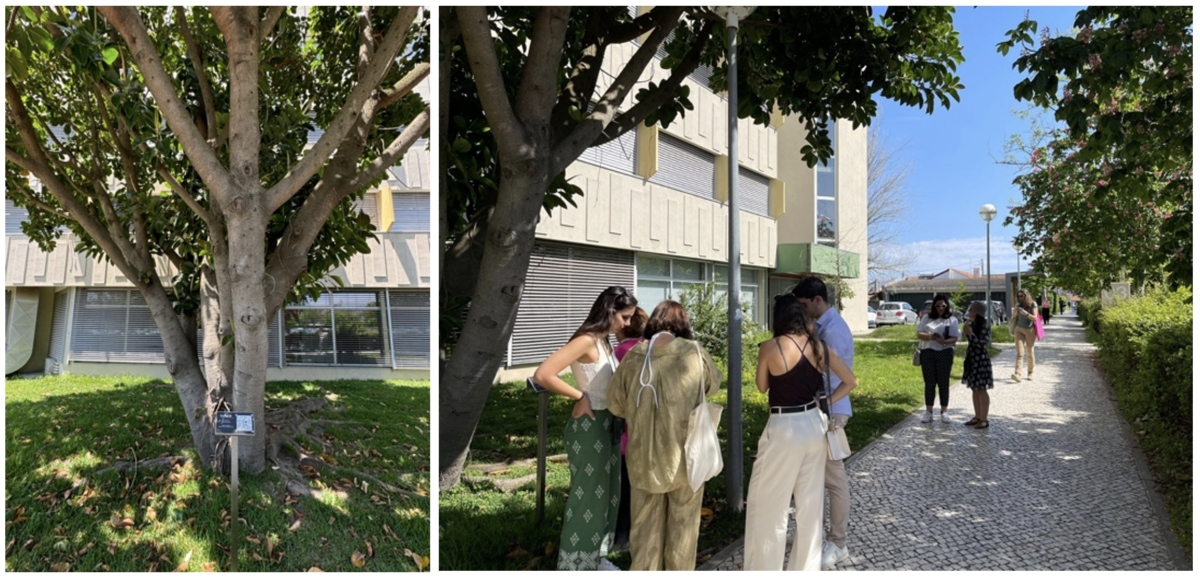
Figure 2 shows a group of players observing the Indian rubber fig tree in the University of Aveiro environment. Once this point of interest is reached, participants observe and explore the AR content that will help them answer the question.
The AR associated with the marker plate is designated as ARBook, a template for dynamic AR that provides detailed information about tree species, including characteristics specific to each plant, its leaves, flowers, fruits, origins, ecology and curiosities. ARBook enhances the user experience by requesting AR information delivery each time the camera identifies a marker. In this sense, the city of Aveiro has a set of plates installed with predefined markers at different strategic points. To answer the question presented in Figure 1, players must participate in the process of exploring curiosities to identify the correct answer.
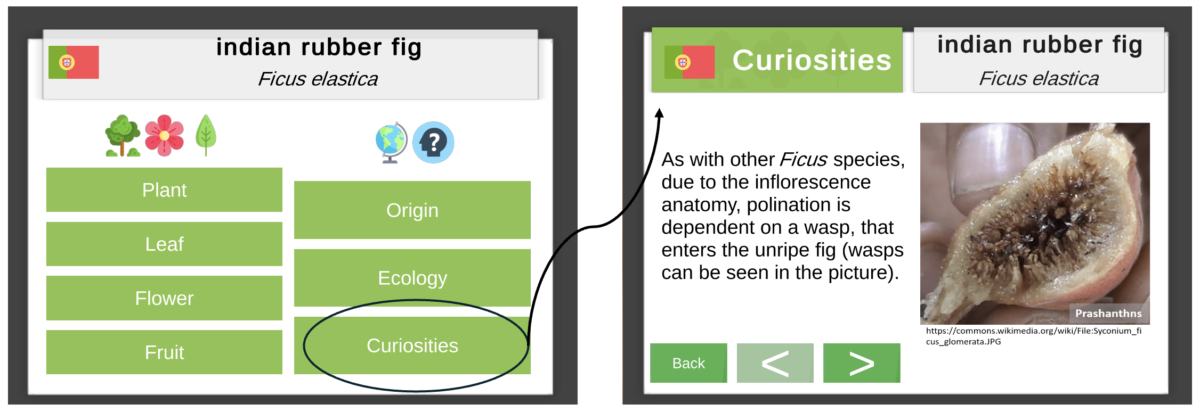
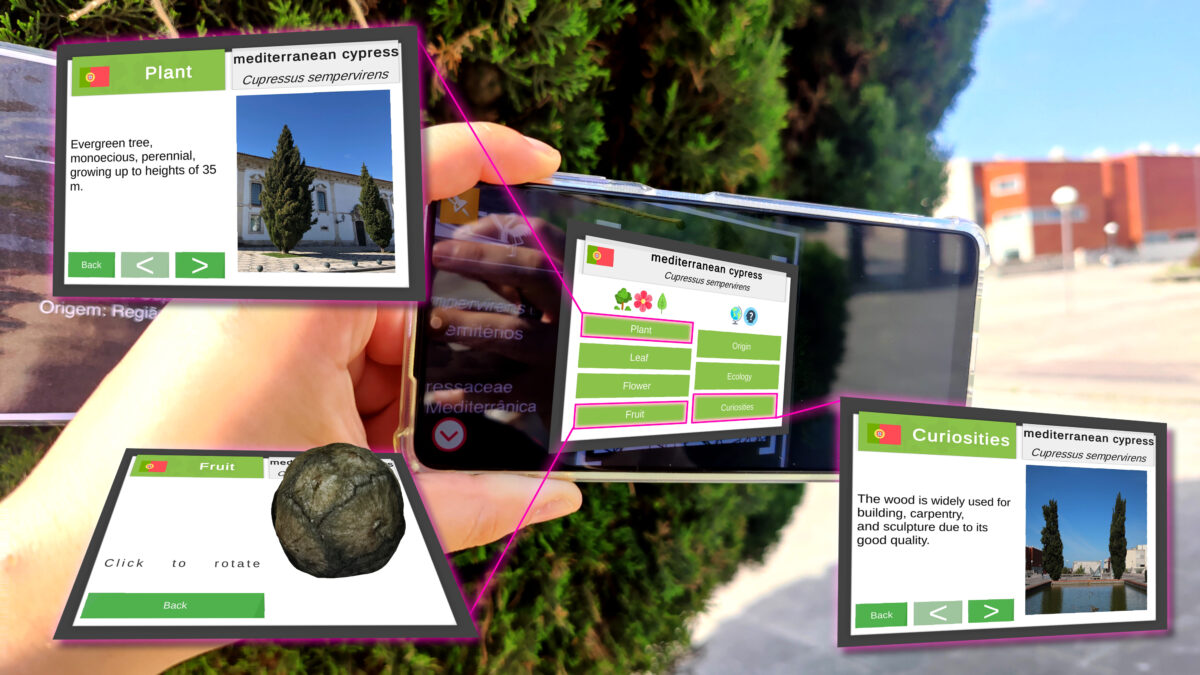
Figure 4 illustrates another example of ARBook with a 3D model of the Mediterranean cypress (Cupressus sempervirens L.). The following illustration shows the cone of the Mediterranean cypress, which is not really a true fruit. To create the 3D models of the leaves, each leaf was photographed from both sides against a white background. The images were then compiled into a model using Blender software. Additionally, the Polycam – Lidar & 3D Scanner application (version 3.1.30) was used to create the 3D models of the flowers and fruits.
What are the next steps for the EduCITY project?
Future research will include a variety of activities within the EduCITY framework, to collect comprehensive data that will be analysed to determine EduCITY’s impact on citizens’ knowledge, skills, values and attitudes. These activities may include implementing expanded AR educational gaming sessions, establishing interactive workshops, organising community engagement events and implementing continuous feedback mechanisms. By collecting and analysing this data, researchers will be able to determine to what extent EduCITY is facilitating the transition to Sustainability. The research will focus on several key areas, including: i) knowledge improvement: the assessment will analyse EduCITY’s impact on people’s understanding of sustainability issues, environmental science and smart city concepts; ii) skills development: assessment of the development of practical skills such as problem solving, critical thinking and technological competence through participation in augmented reality games and other EduCITY tools; iii) sustainability literacy: a questionnaire was developed based on the European sustainability competence framework (GreenComp, European Commission, Joint Research Centre, 2022) to assess these competences after playing with the EduCITY application.
The overall objective of this research is to facilitate citizens’ empowerment to be more informed, skilled and motivated to participate in and drive the transition to sustainability within their cities. The results will not only provide information about the effectiveness of EduCITY, but will also promote future research in these areas.
How does this project fit with the 2030 Agenda and the Sustainable Development Goals?
The 2030 Agenda (United Nations, 2015) identifies sustainable cities and communities as a relevant social objective, which requires the implementation of effective urban planning and management strategies to address the challenges of urbanisation, including traffic management, waste and environmental pollution. To meet these challenges, it is necessary to encourage citizens to reflect on their actions and act sustainably in complex situations. Therefore, it is essential to provide opportunities for the development of key sustainability skills. The growing prevalence of mobile devices allows for the exploration of digital educational games in outdoor environments. When AR content is incorporated, the educational impact can be significantly broadened, leading to a transformation in citizens’ attitudes.
The best SDGs that identify the EduCITY project are SDG4 – Quality education, SDG11 – Sustainable cities and communities, and SDG15 – Life on land.
Bibliografia
European Commission, Joint Research Centre, (2022). GreenComp, the European sustainability competence framework, Publications Office of the European Union, retrieved May 31, 2024.
United Nations (2015), Transforming our world: the 2030 Agenda for Sustainable Development, retrieved May 31, 2024.